
Senior Data Engineer
Help us create the data platform that will change Norwegian healthcare forever.
Location: Oslo, Bergen or from anywhere in Norway
Salary: 1.100–1.250 MNOK/year
🌍 The Opportunity
Municipal healthcare workers make thousands of decisions every day. Right now, most of them are made without reliable data. Aidn is changing that - building the platform that lets municipalities across Norway understand and improve how care is delivered.
Aidn has been building and refining its product for four years, with 80 engineers across a mature engineering organisation. What hasn’t existed until now is a dedicated data engineering function. This is that first role - and it comes with real scope: four years of rich operational healthcare data, a product used by municipalities across Norway, and a genuine need to turn that data into something analytically reliable and useful.
🔧 About Aidn
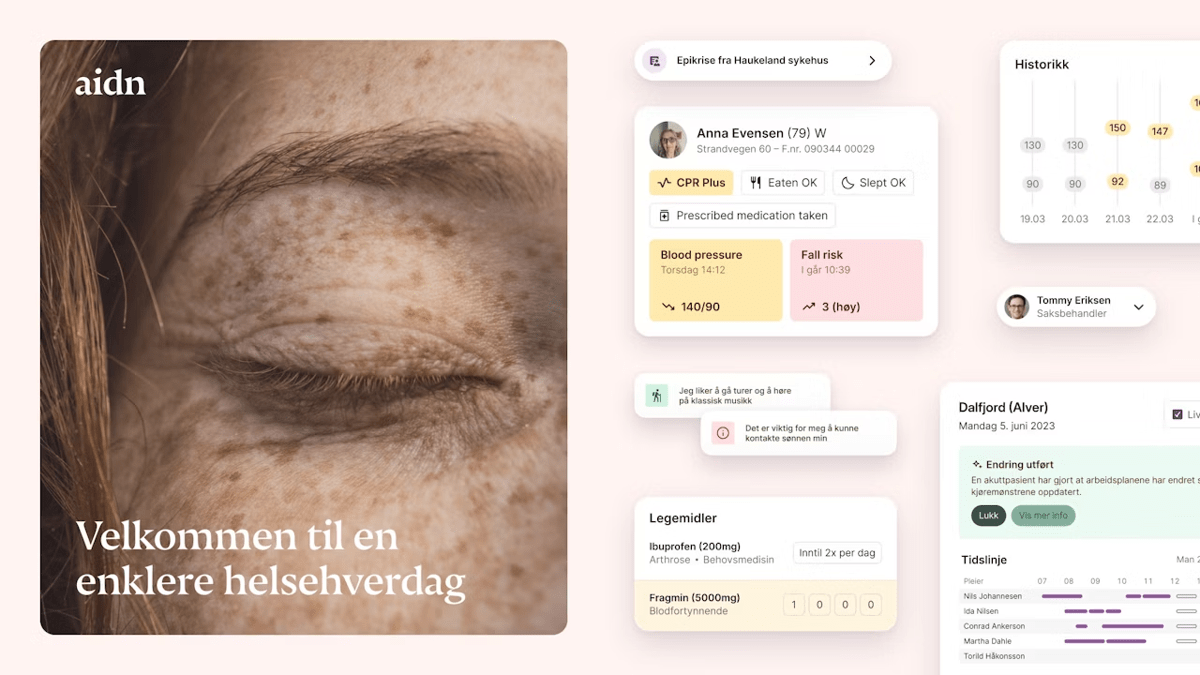
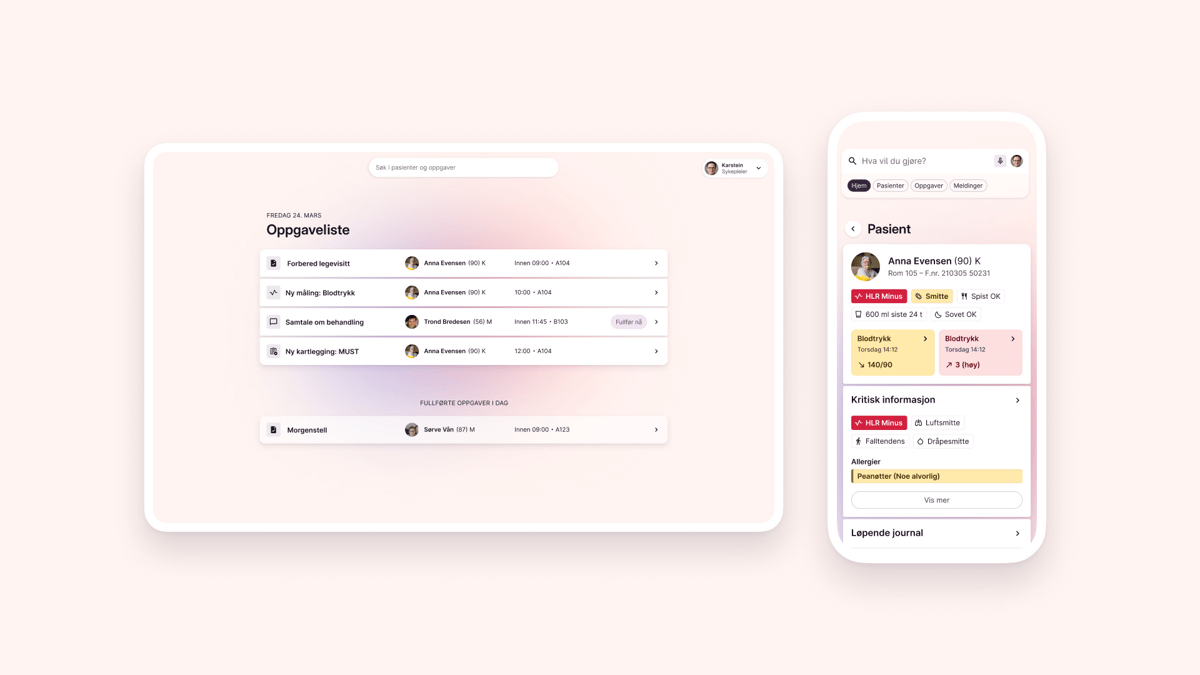
We’re a product company with a size of about 150 people that has grown over four years of development and includes an engineering team of 80 people, building software for municipal healthcare services across Norway. Our systems sit at the heart of how care is planned, delivered, and recorded - generating rich operational and clinical data every day.
As we scale to support more municipalities, we’re evolving from a single operational system into a platform where operational and analytical workloads are properly separated. The goal isn’t a sophisticated data platform for its own sake - it’s giving municipalities and healthcare professionals access to reliable, meaningful data so they can make better decisions in their daily work.
🛠️ The Role
As our first Senior Data Engineer, you’ll design and build the analytical foundation that powers reporting, data sharing, and AI and automation capabilities across municipal healthcare.
Your primary purpose is to empower product teams and data consumers - not to be the bottleneck who does everything yourself. That means building and run core data models and capabilities and infrastructure that others can trust and build on, establishing the patterns and guidelines that let product teams eventually own their own data pipelines and products, and solving foundational problems once so that analysts and engineers don’t have to keep solving them individually.
This is a meaningful distinction. While analysts are often focused on answering specific business questions quickly, your job is to go deeper on the general, structural problems - building the kind of robust foundation that makes everyone else faster. Over time, the goal is a platform where teams across Aidn can build and run their own analytical data products safely and independently.
We’re not looking for someone who will design the perfect architecture upfront and disappear into implementation. We’re looking for someone who builds incrementally, ships things that work, and evolves the platform in step with genuine analytical needs.

🤝 What you'll work on
Establish the analytical data foundation
Design and implement the infrastructure and tooling needed to support analytical workloads separately from operational systems and evolve them over time. Define the transformation patterns and architectural standards that will shape how data flows through Aidn for years to come.
Enable distributed ownership
Build the tooling, documentation, and engineering patterns that make it possible for product teams to contribute and maintain their own data pipelines and products - safely, consistently, and without constant Data Engineering intervention. Our goal is a platform that empowers teams to work autonomously with data.
Build and own the core data models
Create the gold-standard fact and dimension models that represent Aidn’s most important healthcare entities - services delivered, patient interactions, operational capacity. These core models are what product teams, analysts, and data scientists will build on top of. Getting them right matters.
Drive data quality and reliability
Define validation rules, testing strategies, CI/CD pipelines, and monitoring practices that ensure analytical datasets stay correct over time. The municipalities and product teams relying on this data need to trust it completely.
Enable safe, structured data sharing
Contribute to the mechanisms that let municipalities access their own data through APIs and integrations - with proper isolation, privacy controls, and clear contracts.
Collaborate closely with product teams
Work with product teams and domain experts to understand healthcare workflows and help them translate domain knowledge into reliable analytical models. Be the person who makes data work feel approachable for non-specialists.
🔍 The Data We’re Building Towards
The analytical datasets you build should be:
Trustworthy - correct, validated, and observable
Self-describing - documented and understandable without tribal knowledge
Discoverable - easy to find and reason about
Interoperable - safe to integrate and share across municipal boundaries
Secure - with privacy and data isolation treated as first-class concerns
Scalable - able to grow as Aidn onboards more customers and expand our product

✅ What We’re Looking For
We’re looking for a senior engineer who gets energy from building data platforms that solve real problems - not just elegant architectures. Someone who cares about the people downstream of their work: the analysts, the product teams, the healthcare workers making decisions with data you helped make reliable.
You likely have:
A data engineering background rooted in a modern product and technology organisation
Significant hands-on experience in data engineering through building and running a modern data platform
Deep understanding of data modeling - dimensional modeling, analytical data design, and the tradeoffs involved
Experience building transformation layers with dbt or similar tools
A strong sense of how to balance quality and speed - weighing reliability, observability, and correctness in data systems
Experience collaborating closely with product teams to help them translate business processes into analytical models
Comfort making architectural decisions in ambiguous, evolving environments
A interest in enabling others - you find satisfaction in building foundations that make your colleagues more capable
Interested in applying AI tools in data workflows and end user experience
Experience with healthcare data or regulated environments is a plus, but not a prerequisite.

💙Our Technical Environment
Today, our operational data lives in Postgres on Azure. We have just started to establish the first dedicated analytical storage pulling data for analytical purposes out from our production databases. This is the very early stages of the analytical layer you’ll be building and setting the direction for.
Most of the core architectural decisions are still open, and that’s intentional. We want the right person making them - not inheriting someone else’s half-considered choices.
What’s already decided:
Postgres is the source of truth for operational data, and will remain so
We’re on Azure - the analytical infrastructure will live within that ecosystem
We have started using dbt for the transformation layer
What’s still open - and yours to shape:
The analytical store: whether we land on Databricks, Snowflake, Fabric, or something else will depend on our needs and your judgment
How we extract and move operational data from Postgres - change data capture, scheduled extracts, or another approach
How AI impacts our data platform: just as with software engineering and product development, we believe developing data products and the user interfaces to analytical data is changing
What orchestration looks like: how pipelines are scheduled, monitored, and recovered
How municipalities safely access their own data - isolation, contracts, and the right API surface for structured data sharing
The data itself spans four years of operational and clinical healthcare records, currently untapped analytically. Making it reliably accessible - without compromising the integrity of the systems municipalities depend on daily - is the core engineering challenge of this role.

🔋How We Work
We work in focused cycles with clear goals rather than reacting to an endless backlog. We set OKRs that reflect what we want to accomplish, use focus periods to go deep on prioritised work, and flex periods to handle everything else and tie up loose ends.
As the team grows, we expect to run a rotating support model - where team members take turns as the designated data platform support contact for a week at a time. This keeps the rest of the team focused, reduces interruptions, and ensures that the people relying on the platform always have a clear point of contact.
We value autonomy, expect engineers to take ownership of their work end to end, and try to build a culture where it’s easy to ask questions, challenge assumptions, and improve how we work together.
In the first 3–6 months
The foundation is in place and the people around you trust it. Specifically:
The MVP data platform is delivering value to municipalities in production. You have led the work to establish the necessary capabilities needed to deliver on real use cases in production for the municipalities. This also includes the user interfaces to deliver the insights the users are acting on to have an impact.
We think you have started to be the domain authority on Aidn’s data. You can walk any engineer through a couple of core identified healthcare workflows - services, interactions, capacity - and explain exactly how they’re represented in the platform. Product teams come to you for modeling advice, not just fixes.
Reporting no longer touches production. The analytical layer is cleanly separated from operational workloads. The risk of analytical queries affecting live healthcare systems is gone.
Core transformation patterns are established and documented. A handful of other engineers know how to extend the platform without asking you. The patterns you’ve defined are the starting point, not tribal knowledge in your head.
Data quality issues surface before stakeholders report them. You’ve identified the most critical points of failure for municipality reporting and have systematic monitoring in place for them.
In the first 6–12 months
The foundation is paying off - others are building on it, and the platform is becoming a genuine capability rather than a project.
A product team has shipped their first self-owned data product using the patterns and tooling you established - without you doing it for them. Distributed ownership is no longer a goal; it’s happening.
Municipalities can access their own data through stable, well-documented APIs with clear contracts and proper isolation. External trust in the platform is real and earned.
New developers get up to speed in days, not weeks. The documentation, tooling, and modeling guidelines you’ve built make the platform legible to people who weren’t there at the start. This works for a set of roles, not just engineers.
The platform has a clear architectural path forward. The next phase of work is obvious and well-reasoned - not a blank page or a set of competing opinions - because the foundation you’ve built makes the right next steps apparent.
By this point, the measure of success isn’t what you’ve built - it’s what everyone else can now do with data that they couldn’t before.
👋🏼Why Join Aidn
You’ll shape the data platform from the ground up. Aidn has a mature product and engineering organisation, but data engineering is genuinely new here. You won’t inherit someone else’s half-finished architecture - you’ll define the patterns, tooling, and standards the organisation builds on going forward.
The problem is real and the impact is direct. Municipal healthcare workers use our systems every day. The data platform you build will directly influence how care decisions get made - not hypothetically, but in practice, across municipalities throughout Norway.
You’ll be an enabler, not a gatekeeper. The best outcome for this role is a platform that makes everyone around you more capable. If that kind of leverage appeals to you more than being the person with all the answers, you’ll fit right in.
You’ll work in a product-minded engineering culture. We build things because users need them. Your work will be shaped by real analytical needs, not technology for its own sake.
The technical challenges are interesting. Healthcare operational data is rich, complex, and consequential. Making it analytically reliable - correctly modeled, well-tested, and safely shareable across organisational boundaries - is a genuinely hard and rewarding problem.
You’ll grow with the company. As Aidn scales, so does the scope of this role - including the opportunity to help build and lead a data engineering function over time.
Aidn is part of the Kernel cooperation, where we build technology for the next generation of welfare societies. With financial backing in order, we are privileged to be a fully autonomous startup busy building our company from the ground up the way we see fit.
Aidn recognizes and celebrates diversity in all its forms, visible and non-visible in all areas of the work environment. We work to promote an anti-discriminatory environment where everyone feels safe and welcome.
Read our full Diversity, Inclusion & Belonging policy in our handbook here.
Are you curious? We welcome you to check out our employee handbook to get to know us, some of our benefits, and what drives us
- Department
- Technology
- Locations
- Oslo, Bergen, You can work from anywhere in Norway
- Remote status
- Hybrid
